
Social Security COLA 2026: Projecting a 3.5% Increase for Retirees
For millions of Americans relying on Social Security benefits, the annual Cost-of-Living Adjustment (COLA) is a critical determinant of their financial stability. As we look ahead to 2026, early projections suggest a significant 3.5% increase in the Social Security COLA. This potential adjustment, while still preliminary, offers a glimpse into the future purchasing power of retirees and other beneficiaries. Understanding the mechanics behind the Social Security COLA, its historical context, and its projected impact is essential for effective retirement planning and financial management. This comprehensive guide will delve into all aspects of the projected 2026 Social Security COLA, providing insights into its calculation, implications, and what beneficiaries can expect.
Anúncios
The Crucial Role of Social Security COLA
The Social Security COLA serves a vital purpose: to ensure that the purchasing power of Social Security benefits is not eroded by inflation. Without regular adjustments, the fixed income of retirees would steadily lose value over time, making it increasingly difficult to meet daily expenses. The COLA is designed to counteract this effect, allowing beneficiaries to maintain their standard of living. This annual adjustment is not a discretionary decision but rather a calculation based on specific economic data, primarily the Consumer Price Index for Urban Wage Earners and Clerical Workers (CPI-W).
The projected 3.5% increase for the 2026 Social Security COLA is a significant figure, especially when viewed against historical averages. While not as high as the substantial increases seen in 2022 and 2023, it still represents a robust adjustment that could provide much-needed relief for beneficiaries facing ongoing inflationary pressures. For many, Social Security represents a primary, if not the sole, source of income in retirement. Therefore, any adjustment, particularly a positive one, has a direct and profound impact on their daily lives and long-term financial security.
Understanding the Social Security COLA Calculation
The Social Security COLA is determined by the Social Security Administration (SSA) based on a formula tied to the CPI-W. Specifically, the COLA is calculated by comparing the average CPI-W for the third quarter (July, August, and September) of the current year with the average CPI-W for the third quarter of the most recent year in which a COLA was payable. The percentage increase between these two averages, rounded to the nearest tenth of a percent, becomes the COLA for the following year.
Anúncios
For example, to determine the 2026 Social Security COLA, the SSA will compare the average CPI-W for the third quarter of 2025 with the average CPI-W for the third quarter of 2024 (assuming a COLA was payable in 2025). If there is no increase in the CPI-W, or if it decreases, then there is no COLA for that year. This methodology ensures that the adjustment directly reflects changes in the cost of living experienced by a significant portion of the population.
It’s important to differentiate the CPI-W from the more commonly cited Consumer Price Index for All Urban Consumers (CPI-U). The CPI-W specifically tracks consumption patterns of urban wage earners and clerical workers, a demographic that aligns more closely with Social Security beneficiaries. While both indices measure inflation, the CPI-W tends to be slightly more volatile and can sometimes show higher rates of inflation, leading to larger Social Security COLA increases.
The Role of Inflation in COLA Projections
The projected 3.5% Social Security COLA for 2026 is a direct reflection of anticipated inflationary trends. Economists and actuaries make these projections by analyzing current economic data, inflation forecasts, and broader economic indicators. Factors such as energy prices, food costs, housing expenses, and healthcare expenditures all contribute to the overall inflation rate and, consequently, to the projected COLA. A sustained period of inflation, even at moderate levels, will inevitably lead to a higher Social Security COLA to preserve purchasing power.
The current economic climate, characterized by ongoing supply chain adjustments, geopolitical events, and shifts in consumer demand, makes accurate inflation forecasting a complex task. However, the 3.5% projection suggests that while inflation may not reach the peaks of recent years, it is expected to remain a significant factor impacting the cost of living for retirees. This projection provides valuable foresight for beneficiaries, allowing them to anticipate potential adjustments to their income.
Historical Social Security COLA Adjustments: A Retrospective
Examining historical Social Security COLA adjustments provides valuable context for the projected 2026 increase. Over the decades, COLA percentages have varied widely, reflecting different economic environments. There have been years with no COLA, particularly during periods of low inflation or deflation, and years with substantial increases, often following periods of high inflation.
For instance, in the late 1970s and early 1980s, COLA increases were in the double digits, reflecting the rampant inflation of that era. More recently, the 2022 COLA was 5.9%, and the 2023 COLA was a substantial 8.7%, driven by a surge in inflation in the wake of the COVID-19 pandemic and subsequent economic recovery. These recent large adjustments underscore the critical role COLA plays in protecting beneficiaries during periods of high price increases.
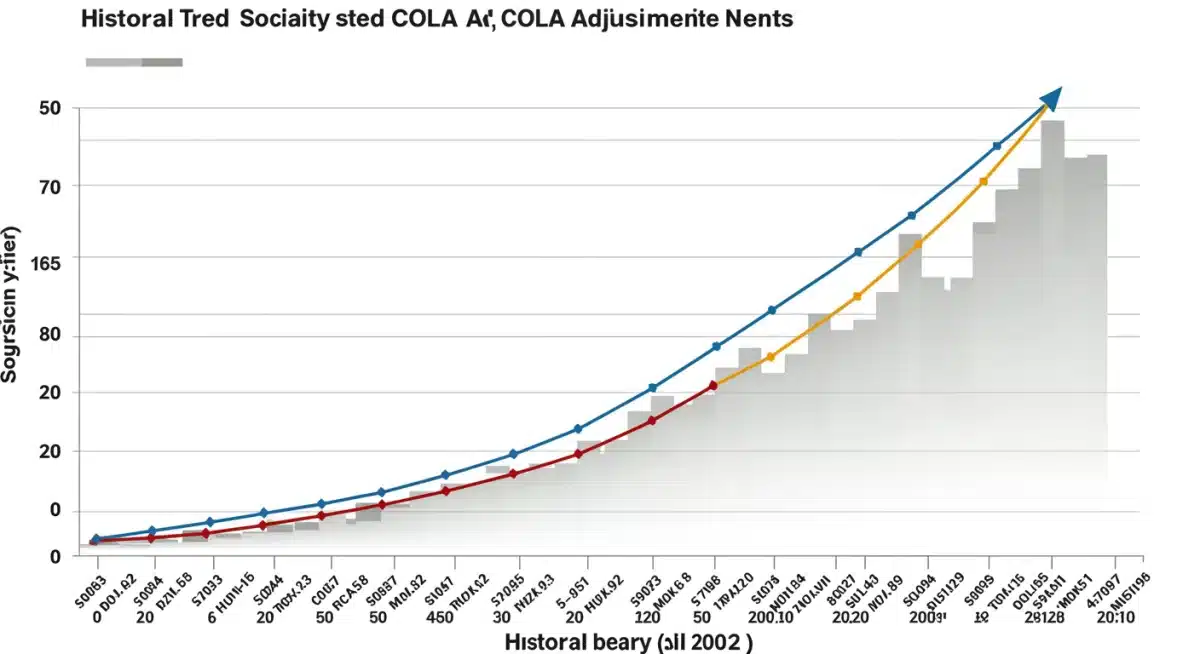
Conversely, there have been years with very modest COLAs, such as 0.3% in 2017, and even three years (2010, 2011, and 2016) with no COLA at all. These periods demonstrate that the Social Security COLA is directly responsive to economic conditions and is not a guaranteed annual increase regardless of inflation. The projected 3.5% for 2026 falls within the range of moderate to significant adjustments seen over the past few decades, indicating a continued, albeit potentially moderating, inflationary environment.
This historical perspective is crucial for understanding the dynamic nature of the Social Security COLA. It is not a fixed percentage but a responsive mechanism designed to adapt to the economic realities faced by retirees. The 3.5% projection for the 2026 Social Security COLA, therefore, reflects the current best estimates of future inflation, aiming to provide an accurate adjustment to benefits.
Impact of a 3.5% Social Security COLA on Retirees
A 3.5% Social Security COLA for 2026 would have a tangible impact on the monthly benefits received by millions of retirees, survivors, and individuals with disabilities. For someone receiving the average Social Security benefit, a 3.5% increase translates to a noticeable boost in their monthly income. While the exact dollar amount will vary based on individual benefit levels, this adjustment can help offset rising costs of living, particularly for essential expenses like groceries, utilities, and healthcare.
Consider a beneficiary currently receiving $1,800 per month. A 3.5% COLA would increase their monthly payment by $63, bringing their new benefit to $1,863. While this might seem like a modest increase to some, for those on a fixed income, every dollar counts. Over the course of a year, this can add up to a significant sum, providing greater financial flexibility and peace of mind.
Addressing Rising Healthcare Costs
One of the most persistent financial challenges for retirees is the escalating cost of healthcare. Medicare Part B premiums, in particular, often consume a portion of Social Security benefits. While the COLA helps to increase overall benefits, the concurrent rise in healthcare costs can sometimes diminish the net gain. However, a robust Social Security COLA can help mitigate the impact of these rising premiums, ensuring that retirees retain more of their adjusted benefits.
It’s important for beneficiaries to understand that while their Social Security checks will increase, other expenses may also continue to climb. Therefore, the 3.5% Social Security COLA should be viewed as one component of a broader financial strategy for retirement. Budgeting, monitoring expenses, and exploring other income sources remain crucial for long-term financial security.
The CPI-W vs. CPI-E: A Debate on Fairness
The use of the CPI-W to calculate the Social Security COLA has been a subject of ongoing debate. Critics argue that the CPI-W, which tracks the spending habits of urban wage earners and clerical workers, does not accurately reflect the expenditure patterns of seniors. They contend that seniors typically spend a larger proportion of their income on healthcare and housing, categories that often experience higher rates of inflation than other goods and services.
An alternative index, the Consumer Price Index for the Elderly (CPI-E), has been proposed as a more appropriate measure for COLA calculations. The CPI-E specifically tracks the spending habits of individuals aged 62 and older. Historical analyses have often shown that the CPI-E tends to rise faster than the CPI-W, suggesting that using the CPI-W may lead to lower Social Security COLA adjustments than what would be necessary to truly maintain the purchasing power of seniors.
If the Social Security COLA were calculated using the CPI-E, the projected 2026 increase might be even higher than 3.5%. This debate highlights a fundamental question about the fairness and accuracy of the current COLA methodology. While there have been discussions and proposals to switch to the CPI-E, legislative action would be required to implement such a change. For now, the CPI-W remains the official index for determining the Social Security COLA.
Forecasting the 2026 Social Security COLA: What Drives the 3.5% Projection?
The 3.5% projection for the 2026 Social Security COLA is based on a multitude of economic factors and forecasts. Key drivers for this projection include:
- Inflationary Pressures: While some inflationary pressures may ease, others, such as those related to services and specific goods, are expected to persist. Energy prices, global supply chain dynamics, and labor costs all play a role in shaping future inflation.
- Economic Growth: The pace of economic growth influences demand and, consequently, prices. Moderate economic growth can lead to steady, albeit not runaway, inflation.
- Federal Reserve Policy: The Federal Reserve’s monetary policy, including interest rate decisions, aims to manage inflation. Its actions can directly impact the overall price environment that informs the Social Security COLA.
- Wage Growth: Strong wage growth can contribute to inflation as businesses pass on higher labor costs to consumers.
- Geopolitical Events: Global events, such as conflicts or disruptions to international trade, can have unforeseen impacts on commodity prices and supply chains, affecting inflation.

These factors are continuously monitored by economic analysts and government agencies. The 3.5% projection for the Social Security COLA for 2026 represents a consensus or a leading estimate based on the best available data and predictive models. It’s important to remember that these are projections, and the final COLA will only be announced in October 2025, after the actual CPI-W data for the third quarter of 2025 becomes available.
Planning for the Future: Incorporating COLA into Retirement Strategy
For current retirees and those nearing retirement, understanding and incorporating the Social Security COLA into their financial planning is paramount. While a 3.5% Social Security COLA is a positive development, it’s crucial to adopt a holistic approach to retirement finances.
Here are some key considerations:
- Budgeting: Regularly review and adjust your budget to account for both increased Social Security income and ongoing changes in expenses.
- Healthcare Costs: Anticipate rising healthcare costs, including Medicare premiums, deductibles, and out-of-pocket expenses. Even with a COLA, these can be significant.
- Investment Strategy: If you have other investments, ensure your portfolio is diversified and aligned with your risk tolerance and financial goals, considering the impact of inflation.
- Tax Implications: A higher Social Security benefit might have tax implications, depending on your total income. Consult with a financial advisor to understand how a COLA could affect your tax liability.
- Delayed Claiming: For those not yet claiming Social Security, remember that delaying benefits past your full retirement age can result in higher monthly payments, which would then be subject to COLA adjustments.
- Monitor Economic News: Stay informed about economic trends and inflation forecasts, as these directly influence future Social Security COLA adjustments.
The Social Security COLA, while essential, is just one piece of the retirement puzzle. A well-rounded financial plan that considers all income sources, expenses, and potential contingencies will provide the most security and peace of mind.
Addressing Common Misconceptions About Social Security COLA
There are several common misconceptions surrounding the Social Security COLA that are worth clarifying:
Misconception 1: The COLA is a raise. While it increases your benefit amount, the COLA’s primary purpose is to maintain purchasing power, not to provide an actual ‘raise’ in real terms. It aims to offset inflation, allowing your benefits to buy roughly the same amount of goods and services as before.
Misconception 2: The COLA is guaranteed every year. As discussed, there have been years with no COLA. The adjustment is entirely dependent on the CPI-W data for the third quarter. If inflation is stagnant or negative, there will be no COLA.
Misconception 3: The COLA fully covers all retiree expenses. While it helps with general inflation, specific expenses like healthcare might outpace the COLA. Retirees often face unique cost burdens that the broad CPI-W might not fully capture.
Misconception 4: The COLA is determined by political will. While Congress could theoretically change the COLA calculation method, the annual adjustment itself is a statutory calculation based on the CPI-W, not a discretionary decision by politicians.
Understanding these points helps beneficiaries set realistic expectations for the Social Security COLA and plan accordingly. The projected 3.5% Social Security COLA for 2026, while positive, should be viewed within this context.
The Broader Economic Picture and Future COLAs
The economic landscape is constantly evolving, and future Social Security COLA adjustments will continue to reflect these changes. Factors such as global economic growth, technological advancements, shifts in labor markets, and fiscal policies will all play a role in determining future inflation rates and, consequently, future COLAs. The long-term solvency of the Social Security program itself is also a recurring topic of discussion, with potential implications for how benefits, including COLAs, are calculated and distributed in the distant future.
While the focus here is on the projected 2026 Social Security COLA, it’s important to maintain a long-term perspective. Beneficiaries and future retirees should stay engaged with economic news and policy discussions related to Social Security to understand how these broader trends might affect their financial outlook. The Social Security Administration provides regular updates and detailed information on their website, which is an invaluable resource for staying informed.
Conclusion: Navigating the Projected 3.5% Social Security COLA for 2026
The projection of a 3.5% Social Security COLA for 2026 offers a promising outlook for retirees and other beneficiaries. This expected increase, driven by ongoing inflationary trends, underscores the Social Security system’s commitment to preserving the purchasing power of its recipients. While still a projection, it provides a valuable benchmark for financial planning and budgeting in the coming years.
Understanding how the Social Security COLA is calculated, its historical context, and its potential impact is crucial for all beneficiaries. This adjustment is a vital mechanism that helps millions of Americans maintain their standard of living in retirement. As we approach the official announcement in October 2025, staying informed and proactively planning will enable beneficiaries to best leverage the projected 3.5% Social Security COLA to secure their financial well-being.
For more detailed information and official updates, always refer to the Social Security Administration’s official website.