Maximize Your 2025 Social Security Benefits: Insider’s Guide

Anúncios
Strategic decisions regarding claiming age, earnings, and benefit types are crucial for maximizing your 2025 Social Security benefits, directly impacting your financial well-being in retirement.
For many Americans, Social Security represents a cornerstone of their retirement income. Understanding how to optimize your payouts can significantly impact your financial security. This comprehensive guide delves into strategies for Unlocking Your Full 2025 Social Security Benefits: An Insider’s Guide to Maximizing Your Monthly Payout, ensuring you make informed decisions for your future.
Anúncios
Understanding the Basics of Social Security Benefits
Before diving into advanced strategies, it’s essential to grasp the fundamental principles of Social Security. These benefits are designed to provide a safety net for retirees, disabled individuals, and survivors. Your monthly payout is primarily determined by your earnings history, specifically your highest 35 years of indexed earnings.
The Social Security Administration (SSA) calculates your Primary Insurance Amount (PIA), which is the benefit you receive if you claim at your Full Retirement Age (FRA). This FRA varies depending on your birth year. For those turning 62 in 2025, the FRA is likely to be 67, a critical factor in benefit calculations.
Anúncios
How Your Earnings History Impacts Benefits
Your work record is the bedrock of your Social Security benefits. The SSA uses a formula that considers your average indexed monthly earnings (AIME) over your 35 highest-earning years. If you have fewer than 35 years of earnings, zero-earning years will be factored into the average, reducing your overall benefit.
- High Earnings Years: Focus on maximizing your income during your working years, especially those likely to be among your top 35.
- Consistent Work History: A continuous work history helps ensure you accumulate enough credits and avoid zero-earning years.
- Indexing: Your past earnings are indexed to account for changes in average wages over time, ensuring your benefits reflect current economic realities.
Understanding these foundational elements allows you to appreciate the strategies that follow. Each decision you make regarding your work life and claiming age directly influences the size of your Social Security check.
Strategic Claiming Age: The Most Critical Decision
The age at which you choose to start receiving Social Security benefits is arguably the most impactful decision you’ll make regarding your retirement income. While you can claim as early as age 62, or as late as age 70, each option comes with significant financial implications.
Claiming early, before your Full Retirement Age (FRA), results in a permanent reduction of your monthly benefit. Conversely, delaying beyond your FRA, up to age 70, earns you delayed retirement credits, significantly boosting your annual payout. This trade-off between immediate income and a larger future benefit requires careful consideration of your personal circumstances, health, and financial needs.
The Full Retirement Age (FRA) Explained
Your FRA is the age at which you are entitled to 100% of your Primary Insurance Amount (PIA). For individuals born in 1960 or later, the FRA is 67. Claiming at this age avoids any reductions for early filing and doesn’t accrue delayed retirement credits.
- Born 1943-1954: FRA is 66.
- Born 1955: FRA is 66 and 2 months.
- Born 1956: FRA is 66 and 4 months.
- Born 1957: FRA is 66 and 6 months.
- Born 1958: FRA is 66 and 8 months.
- Born 1959: FRA is 66 and 10 months.
- Born 1960 or later: FRA is 67.
Knowing your specific FRA is the first step in planning your claiming strategy. It serves as the benchmark against which early and delayed claiming are measured.
Benefits of Delaying Beyond FRA
Delaying your claim past your FRA, up to age 70, can lead to a substantial increase in your monthly benefit. For each year you delay, your benefit increases by approximately 8%, thanks to delayed retirement credits. This increase is permanent and compounds annually.
For example, if your FRA is 67 and you delay claiming until age 70, your monthly benefit could be 24% higher than what you would receive at your FRA. This strategy is particularly appealing for those who are in good health, have other sources of income, and anticipate a long retirement. The cumulative effect of these higher payments over a lifetime can be immense.
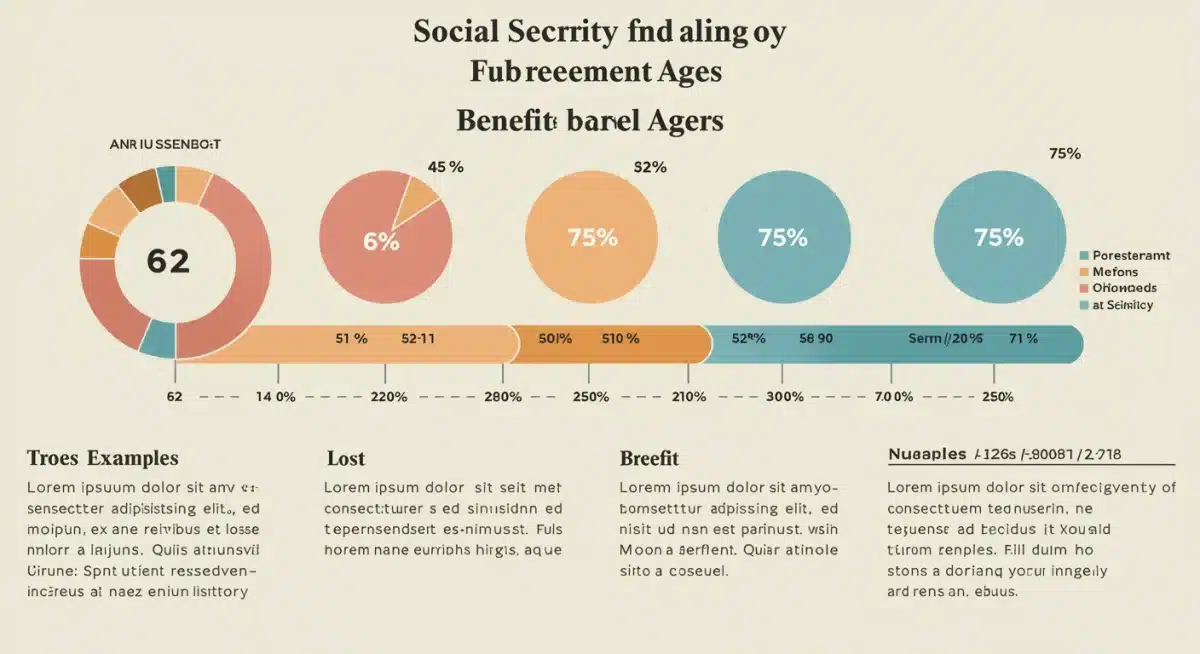
Making an informed decision about your claiming age is paramount. It requires a thoughtful assessment of your financial situation, health, and longevity expectations.
Maximizing Spousal and Survivor Benefits
Social Security benefits extend beyond individual work records, offering crucial protections for spouses and survivors. Understanding how these benefits work can significantly boost your household’s overall Social Security income, especially for couples.
Spousal benefits allow an eligible spouse to receive up to 50% of their partner’s Full Retirement Age (FRA) benefit. Survivor benefits provide a lifeline to widows, widowers, and eligible children after a worker’s death. Strategic coordination between spouses is key to optimizing these often-overlooked benefits.
Understanding Spousal Benefits
If you are married, you may be eligible for spousal benefits based on your spouse’s work record. This benefit can be particularly advantageous if one spouse has a significantly lower earning history or did not work outside the home. To claim spousal benefits, your spouse must have already filed for their own retirement benefits.
- Eligibility: You must be at least 62 years old, or caring for a child under 16 or disabled.
- Benefit Amount: Up to 50% of your spouse’s FRA benefit. If you claim spousal benefits before your own FRA, your benefit will be reduced.
- Coordination: Couples can strategize by having one spouse claim early while the other delays, or by comparing individual benefits to spousal benefits to claim the higher amount.
It’s important to note that if you are eligible for both your own retirement benefit and a spousal benefit, the SSA will pay you the higher of the two amounts. You cannot receive both in full.
Navigating Survivor Benefits
Survivor benefits provide financial support to eligible family members after a worker’s death. This crucial safety net can significantly impact the financial well-being of surviving spouses, children, and dependent parents.
A widow or widower can receive up to 100% of the deceased worker’s benefit if they claim at their own FRA. If they claim earlier, the benefit will be reduced. Dependent children under 18 (or 19 if still in high school) or disabled children can also receive benefits.
For couples, the decision of when the higher-earning spouse claims benefits can directly affect the survivor benefit amount. Delaying the higher earner’s claim until age 70 ensures the surviving spouse receives the maximum possible benefit.
Working in Retirement: Earnings Limits and Their Impact
Many individuals choose to continue working part-time or full-time during their early retirement years, either out of necessity or desire. While working can supplement your income, it’s crucial to understand how earnings limits can affect your Social Security benefits if you claim before your Full Retirement Age (FRA).
Exceeding these limits can lead to temporary reductions in your monthly payout, which the SSA will withhold. However, these withheld benefits are not lost forever; they contribute to a recalculation of your benefit at your FRA, potentially leading to higher payments later.
Understanding the Social Security Earnings Test
The Social Security earnings test applies only if you are receiving benefits before your FRA. If you are past your FRA, you can earn any amount without your benefits being reduced. For 2025, the specific earnings limits will be announced later, but they typically increase each year.
- Before FRA: If you are under your FRA for the entire year, the SSA deducts $1 from your benefits for every $2 you earn above a certain annual limit.
- In the Year You Reach FRA: In the year you reach your FRA, a higher earnings limit applies. The SSA deducts $1 from your benefits for every $3 you earn above a different, higher limit, but only for earnings before the month you reach your FRA.
- At or After FRA: Once you reach your FRA, the earnings limit no longer applies, and you can earn any amount without your benefits being reduced.
It’s vital to monitor these limits closely, especially if you plan to work while receiving early Social Security benefits. Failing to do so can lead to unexpected benefit reductions.
Recalculation at Full Retirement Age
Any benefits withheld due to the earnings test are not permanently lost. When you reach your FRA, the SSA recalculates your benefit to account for the months benefits were withheld. This recalculation effectively gives you credit for those months, leading to a higher monthly payment for the remainder of your retirement.
This means that while working before your FRA might temporarily reduce your current benefits, it can ultimately lead to a larger monthly check in the long run. It’s a trade-off that requires careful financial planning to determine if working while receiving early benefits aligns with your overall retirement goals.
Cost-of-Living Adjustments (COLAs) and Future Projections
One of the most significant features of Social Security is its protection against inflation through annual Cost-of-Living Adjustments (COLAs). These adjustments ensure that the purchasing power of your benefits is maintained over time, a crucial factor for long-term financial security in retirement.
While the exact COLA for 2025 will not be announced until the fall of 2024, understanding how these adjustments are determined and what factors influence them can help you anticipate future changes to your monthly payout.
How COLAs Are Calculated
COLAs are determined by the Social Security Administration (SSA) based on the Consumer Price Index for Urban Wage Earners and Clerical Workers (CPI-W). Specifically, the SSA compares the average CPI-W for the third quarter of the current year (July, August, September) with the average for the third quarter of the last year a COLA was granted.
If there’s an increase, that percentage increase is applied to Social Security benefits starting in January of the following year. If there’s no increase or a decrease, benefits remain the same. This mechanism is designed to reflect changes in the cost of living for a significant portion of the population.
- Inflation Indicator: The CPI-W serves as the primary measure of inflation for COLA calculations.
- Annual Review: COLAs are reviewed and announced annually, typically in October.
- Benefit Protection: COLAs are vital for maintaining the real value of benefits over extended periods of retirement.
Forecasting future COLAs can be challenging, as they depend heavily on economic conditions. However, staying informed about inflation trends can provide some insight into potential adjustments.
Projections for the 2025 COLA
While definitive figures for the 2025 COLA are still months away, various economic forecasts and analyses can offer insights. Factors such as energy prices, food costs, and overall economic growth will play a significant role in determining the final adjustment.
For example, if inflation remains elevated, a more substantial COLA might be expected. Conversely, a slowdown in inflation could result in a smaller adjustment. Retirees and those nearing retirement should monitor economic news and projections from reliable sources to anticipate how their benefits might change.
It’s important to remember that these are projections and not guarantees. The official announcement from the SSA in the fall of 2024 will provide the definitive 2025 COLA figure. Planning for a range of potential adjustments is a prudent approach to retirement budgeting.
Navigating Medicare Premiums and Social Security
For most beneficiaries, Medicare Part B premiums are automatically deducted from their Social Security checks. This direct deduction can significantly impact your net monthly Social Security payout. Understanding how these premiums are determined and what factors can influence them is crucial for accurate financial planning, especially as you approach 2025.
The standard Medicare Part B premium changes annually, but some individuals pay more due to the Income-Related Monthly Adjustment Amount (IRMAA). Being aware of these rules can help you plan your income to minimize premium costs.
Medicare Part B Premiums Explained
Medicare Part B covers doctor’s services, outpatient care, and some preventive services. The standard monthly premium for Part B is set annually by the Centers for Medicare & Medicaid Services (CMS). This amount is typically announced in the fall, alongside the Social Security COLA, for the following year.
- Automatic Deduction: For most beneficiaries, premiums are deducted directly from Social Security benefits.
- Annual Changes: The premium amount can change each year, influenced by healthcare costs and legislative factors.
- Hold Harmless Provision: This provision generally prevents your Part B premium increase from exceeding your Social Security COLA, protecting your net benefit. However, it doesn’t apply to everyone, especially those subject to IRMAA.
It’s important to factor in these deductions when calculating your expected net Social Security income. Overlooking them can lead to an overestimation of your available funds.
Income-Related Monthly Adjustment Amount (IRMAA)
Higher-income beneficiaries pay a higher Medicare Part B premium, known as the Income-Related Monthly Adjustment Amount (IRMAA). IRMAA is based on your Modified Adjusted Gross Income (MAGI) from two years prior. For 2025 premiums, your 2023 MAGI will be used.
If your MAGI exceeds certain thresholds, you will pay not only the standard Part B premium but also an additional IRMAA amount. These thresholds are adjusted annually. Careful tax planning, especially in the years leading up to and during retirement, can help manage your MAGI and potentially avoid or reduce IRMAA surcharges.
Understanding the interplay between your income, Medicare premiums, and Social Security benefits is a critical component of maximizing your overall financial well-being in retirement. Proactive planning can help you keep more of your Social Security payout.
Future Changes and Legislative Outlook for 2025
Social Security is a dynamic program, subject to ongoing discussions and potential legislative adjustments. While significant overhauls are often debated, understanding the current financial health of the program and potential future changes can help beneficiaries and prospective retirees plan more effectively for 2025 and beyond.
The program’s long-term solvency is a recurring topic, and various proposals are often put forth to address projected shortfalls. Staying informed about these discussions is crucial for anticipating any shifts that might affect your benefits.
The State of Social Security’s Trust Funds
The Social Security program is funded primarily through payroll taxes. These taxes flow into two trust funds: the Old-Age and Survivors Insurance (OASI) Trust Fund and the Disability Insurance (DI) Trust Fund. While the program currently pays out more in benefits than it collects in taxes, it relies on these trust funds to cover the difference.
- OASI Fund: Projected to be able to pay 100% of scheduled benefits until the mid-2030s.
- Long-Term Solvency: Without legislative action, the trust funds are projected to be able to pay only about 80% of scheduled benefits after the mid-2030s.
- Annual Reports: The Social Security Administration (SSA) and the Treasury Department issue annual reports detailing the financial state of the trust funds.
It’s important to note that even if the trust funds were to be depleted, Social Security would still be able to pay a significant portion of promised benefits from ongoing tax revenues. The program is not expected to “run out of money” entirely.
Potential Legislative Actions and Their Impact
To address the projected long-term shortfall, various legislative proposals are frequently discussed. These proposals often fall into categories such as increasing revenue, reducing benefits, or a combination of both. Examples include:
- Raising the Full Retirement Age: Gradually increasing the age at which full benefits are received.
- Increasing the Payroll Tax Rate: A modest increase in the Social Security tax rate for workers and employers.
- Adjusting the Earnings Cap: Applying Social Security taxes to a higher amount of earnings, or eliminating the cap entirely.
- Changing the COLA Formula: Modifying how cost-of-living adjustments are calculated, potentially leading to smaller annual increases.
While it’s impossible to predict which, if any, of these proposals might become law, staying abreast of the legislative landscape is a prudent approach. Any changes could impact future beneficiaries and those already receiving benefits. However, typically, changes are phased in over time and often include protections for current retirees.
| Key Strategy | Benefit Impact |
|---|---|
| Delay Claiming Age | Significantly increases monthly benefits by up to 8% per year past FRA, until age 70. |
| Optimize Spousal Benefits | Allows eligible spouses to claim up to 50% of partner’s FRA benefit, enhancing household income. |
| Manage Earnings Limits | Avoids temporary benefit reductions if working before FRA; withheld benefits are later recouped. |
| Understand COLAs | Ensures benefits keep pace with inflation, protecting purchasing power over time. |
Frequently Asked Questions About 2025 Social Security Benefits
For individuals born in 1960 or later, the Full Retirement Age (FRA) is 67. If you reach age 62 in 2025, your FRA will be 67, impacting when you can claim your full, unreduced benefits.
Claiming before your FRA results in a permanent reduction of benefits. Delaying beyond your FRA, up to age 70, earns you delayed retirement credits, increasing your monthly payout by approximately 8% per year.
Yes, but if you are under your FRA, your benefits may be reduced if your earnings exceed certain limits. Once you reach your FRA, there are no earnings limits, and you can earn any amount without penalty.
The 2025 COLA will be based on the Consumer Price Index for Urban Wage Earners and Clerical Workers (CPI-W) from the third quarter of 2024. It aims to adjust benefits to keep pace with inflation.
For most beneficiaries, Medicare Part B premiums are automatically deducted from Social Security benefits. Higher-income individuals may pay more due to the Income-Related Monthly Adjustment Amount (IRMAA).
Conclusion
Navigating the complexities of Social Security benefits for 2025 requires careful planning and a thorough understanding of the program’s rules. From strategically choosing your claiming age to optimizing spousal benefits and understanding the impact of earnings limits and COLAs, every decision plays a role in maximizing your monthly payout. By applying the insights from this guide, you can make informed choices that secure a more robust and comfortable financial future in retirement. Remember, consulting with a financial advisor can provide personalized guidance tailored to your unique circumstances.