Retirement Planning 2026: Social Security & Age 67 Withdrawal Strategy

Anúncios
Retirement Planning in 2026: How New Social Security Projections Affect Your Withdrawal Strategy by Age 67
As the calendar pages turn, the future of retirement planning continues to evolve, bringing with it new considerations and challenges. For those eyeing retirement in 2026, particularly individuals approaching age 67, understanding the intricate dance between personal savings, market fluctuations, and the ever-changing landscape of Social Security is paramount. The decisions made today will significantly shape the financial comfort and security of your golden years. This comprehensive guide will delve into the critical aspects of Retirement Planning 2026, focusing specifically on how new Social Security projections might impact your withdrawal strategy if you plan to retire at age 67.
Anúncios
The year 2026 holds particular significance for many. For a substantial cohort of the population, it marks the year they reach their full retirement age (FRA) for Social Security benefits. This milestone, coupled with the latest Social Security projections, necessitates a proactive and informed approach to financial planning. We will explore the nuances of these projections, discuss how to optimize your Social Security claiming strategy, and provide actionable insights into crafting a robust withdrawal plan that ensures your financial well-being well into retirement.
Understanding Your Full Retirement Age (FRA) and Social Security in 2026
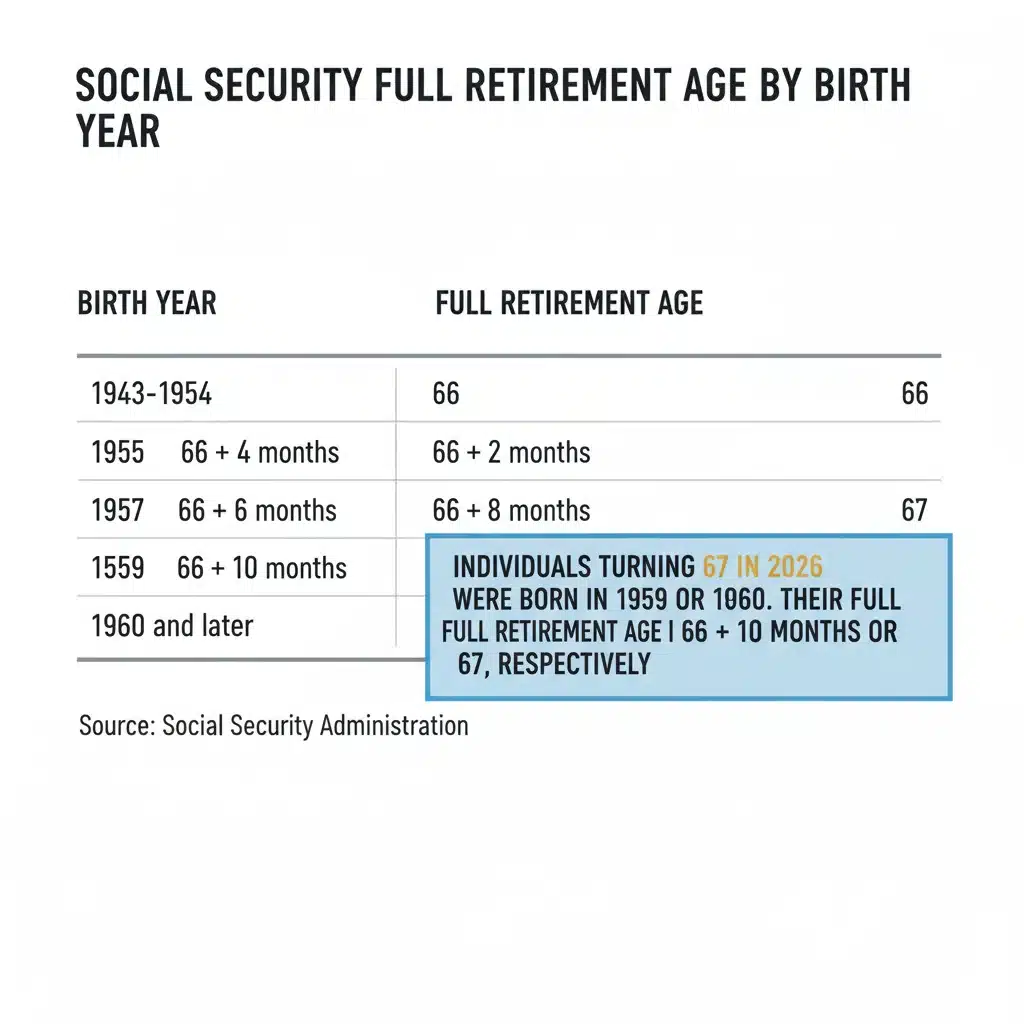
The concept of Full Retirement Age (FRA) is a cornerstone of Social Security benefits. For anyone born in 1960 or later, your FRA is 67. This means that if you were born in 1959, your FRA is 66 and 10 months, but if you were born in 1960, your FRA is 67. Therefore, individuals turning 67 in 2026 are primarily those born in 1959 or 1960, depending on their birth month. Reaching your FRA is crucial because it’s the age at which you are entitled to receive 100% of your primary insurance amount (PIA).
Claiming Social Security benefits before your FRA results in a permanent reduction of your monthly benefit amount. Conversely, delaying beyond your FRA can lead to delayed retirement credits, increasing your monthly benefit up to age 70. This flexibility presents a critical decision point in Retirement Planning 2026.
Anúncios
New Social Security projections, released annually by the Social Security Administration (SSA) Board of Trustees, provide an outlook on the program’s financial health. These projections, while not definitive predictions, offer valuable insights into potential changes in benefit levels, cost-of-living adjustments (COLAs), and the overall solvency of the trust funds. For 2026, these projections will be particularly relevant as a large segment of the population enters their prime claiming window.
Key aspects of these projections often include:
- Trust Fund Solvency: The projected depletion date of the Old-Age and Survivors Insurance (OASI) Trust Fund. While this date is often a point of concern, it’s important to remember that even if depleted, Social Security would still be able to pay a significant portion of scheduled benefits through ongoing tax revenues.
- Cost-of-Living Adjustments (COLAs): Annual adjustments made to benefits to counteract inflation. Understanding expected COLAs helps in projecting future income.
- Demographic Shifts: Changes in birth rates, mortality rates, and immigration patterns that influence the worker-to-beneficiary ratio.
These factors, while seemingly broad, directly influence individual benefit calculations and overall Retirement Planning 2026 strategies. Staying informed about the latest reports from the SSA is a fundamental step in crafting an effective retirement plan.
Navigating Social Security Projections for Your Age 67 Withdrawal Strategy
For those planning to start Social Security benefits at age 67 in 2026, the latest projections offer a critical lens through which to view your future income. While the headline news often focuses on the long-term solvency of the program, it’s essential to understand the immediate implications for your personal benefits.
One of the most common concerns is whether benefits will be cut. The SSA’s projections typically indicate that if no legislative action is taken, the OASI Trust Fund may only be able to pay a certain percentage of scheduled benefits after a particular year. For instance, if the projection for 2026 suggests benefits might be reduced by 20% in the future (e.g., around 2033-2035), this doesn’t mean your 2026 benefits will be immediately cut. It means that future legislative changes might be necessary to avoid such reductions for later retirees.
However, this uncertainty can and should influence your Retirement Planning 2026. If you’re considering drawing benefits at age 67, you might factor in a conservative estimate for future benefit levels. This could mean:
- Building a Larger Safety Net: Increasing your personal savings to compensate for any potential future reduction in Social Security income.
- Diversifying Income Streams: Relying less solely on Social Security and more on pensions, investments, or part-time work.
- Re-evaluating Claiming Age: While planning for age 67, you might explore the pros and cons of delaying benefits to age 70 to maximize your guaranteed income, especially if you have other resources to cover the gap.
It’s crucial to remember that Congress has historically acted to address Social Security’s financial challenges, and a complete collapse of the system is highly improbable. However, prudent planning involves considering various scenarios. Utilizing the SSA’s online tools, such as the Retirement Estimator, can provide personalized projections based on your earnings record and different claiming ages, which is invaluable for Retirement Planning 2026.
Crafting Your Optimal Withdrawal Strategy at Age 67
Deciding when and how to withdraw funds from your retirement accounts is as critical as saving them. For those retiring at age 67, aligning your Social Security claiming strategy with your personal savings withdrawal plan is key to a sustainable retirement. Here’s how to approach it:
1. The 4% Rule Revisited in 2026
The traditional 4% rule suggests withdrawing 4% of your portfolio in the first year of retirement, adjusted for inflation annually. While a good starting point, its applicability in 2026 needs careful consideration. Factors like current interest rates, market volatility, and your personal risk tolerance can influence its effectiveness. With potential changes in Social Security projections, a more dynamic withdrawal strategy might be beneficial.
Consider a variable withdrawal strategy where your withdrawal rate adjusts based on market performance. For instance, in strong market years, you might withdraw slightly more, and in down years, you might reduce your withdrawal or draw more from cash reserves. This flexibility can significantly extend the longevity of your portfolio, especially crucial for those starting withdrawals at age 67.
2. Integrating Social Security with Your Portfolio Withdrawals
The timing of your Social Security benefits directly impacts how much you need to withdraw from your personal savings. If you claim Social Security at age 67, your monthly benefit will be 100% of your PIA. This consistent income stream can cover a significant portion of your basic living expenses, reducing the immediate pressure on your investment portfolio.
Alternatively, some retirees choose to delay Social Security until age 70, allowing their benefits to grow by 8% per year (plus COLAs). In this scenario, you would need to rely more heavily on your personal savings (e.g., 401(k), IRA, taxable accounts) during the 67-70 age window. This strategy, while requiring more initial portfolio withdrawals, results in a higher guaranteed income for the rest of your life, offering a powerful hedge against longevity risk and potential future Social Security adjustments. The decision hinges on your current health, other income sources, and overall financial comfort with higher early withdrawals.
3. Prioritizing Tax-Efficient Withdrawals
Tax planning is an often-overlooked but vital component of your withdrawal strategy. Different retirement accounts are taxed differently:
- Tax-Deferred Accounts (401(k), Traditional IRA): Withdrawals are taxed as ordinary income.
- Tax-Free Accounts (Roth IRA, Roth 401(k)): Qualified withdrawals are tax-free.
- Taxable Accounts (Brokerage Accounts): Capital gains and dividends are taxed.
A smart withdrawal strategy involves a tax diversification
approach, drawing from different account types to manage your taxable income each year. For instance, in years where you anticipate higher income (e.g., a large capital gain from selling an asset), you might draw more from tax-free Roth accounts. In years with lower income, you could tap into tax-deferred accounts at a lower marginal tax rate. This strategy becomes particularly important when you start receiving Social Security benefits, as a portion of those benefits can become taxable depending on your provisional income
.
4. Accounting for Healthcare Costs
Healthcare expenses are a major concern for retirees. Even with Medicare, out-of-pocket costs can be substantial. When planning your withdrawals for Retirement Planning 2026, ensure you’ve adequately budgeted for premiums, deductibles, co-pays, and services not covered by Medicare (like dental, vision, and hearing aids). Consider a Health Savings Account (HSA) if you’re eligible, as it offers a triple tax advantage and can be a powerful tool for healthcare savings in retirement.
The Impact of Economic Conditions on Retirement Planning in 2026
The broader economic environment in 2026 will also play a significant role in your retirement strategy. Factors such as inflation, interest rates, and market performance can either bolster or challenge your plans.
Inflation’s Erosion of Purchasing Power
Inflation is a persistent threat to retirement savings. While Social Security benefits typically receive COLAs, these adjustments might not always keep pace with your personal inflation rate, especially for specific goods and services like healthcare. When considering your withdrawal strategy, it’s prudent to assume a reasonable inflation rate (e.g., 2-3%) and ensure your portfolio is structured to grow at a rate that at least matches or exceeds this, post-tax. This is where a well-diversified portfolio, including inflation-hedging assets, becomes critical for successful Retirement Planning 2026.
Interest Rates and Fixed Income
Interest rates directly impact the returns on fixed-income investments like bonds and Certificates of Deposit (CDs). Higher interest rates can be beneficial for new bond purchases, offering more income, but can also lead to a decrease in the value of existing bonds. For retirees relying on fixed income for a portion of their portfolio, understanding the interest rate environment in 2026 will be crucial for managing risk and optimizing returns. This also affects the viability of annuities, which can provide guaranteed income streams but are sensitive to prevailing interest rates.
Market Volatility and Investment Strategy
Market volatility is a constant in investing. For those entering retirement, a significant market downturn early in retirement (sequence of returns risk) can have a devastating impact on portfolio longevity. To mitigate this, many financial advisors recommend a more conservative asset allocation as you approach and enter retirement, gradually shifting from growth-oriented assets (stocks) to income-generating and capital-preserving assets (bonds, cash equivalents).
However, a purely conservative approach might not provide enough growth to combat inflation over a multi-decade retirement. Therefore, a balanced approach is often best, maintaining some exposure to equities for growth while having sufficient cash and fixed income to cover several years of living expenses without needing to sell investments in a down market. This nuanced approach is essential for effective Retirement Planning 2026.

Key Steps for Your 2026 Retirement Plan at Age 67
To ensure a smooth transition into retirement at age 67 in 2026, consider these actionable steps:
1. Review Your Social Security Statement Annually
The SSA provides an annual statement detailing your earnings record and estimated benefits at different claiming ages. Review this statement carefully for accuracy. Any discrepancies could impact your future benefits. This is your primary tool for personalized Retirement Planning 2026 regarding Social Security.
2. Run Multiple Scenarios with Your Financial Advisor
Work with a qualified financial advisor to model various retirement scenarios. This should include:
- Different Social Security Claiming Ages: Compare claiming at 67 versus delaying to 70.
- Varying Withdrawal Rates: Test different initial withdrawal percentages and how they respond to market fluctuations.
- Healthcare Cost Projections: Incorporate realistic estimates for medical expenses.
- Inflationary Assumptions: Build in different inflation rates to see their impact.
A good advisor can help you stress-test your plan against various economic conditions and potential Social Security changes, ensuring your Retirement Planning 2026 is robust.
3. Optimize Your Asset Allocation
As you near retirement, revisit your investment portfolio’s asset allocation. Ensure it aligns with your risk tolerance and your need for both growth and capital preservation. A common strategy is to gradually reduce your exposure to highly volatile assets as retirement approaches, but avoid becoming overly conservative, which could hinder long-term growth.
4. Build a Cash Reserve (Emergency Fund)
Having a significant cash reserve (e.g., 1-3 years of living expenses) in a high-yield savings account or short-term CDs can provide a buffer against market downturns. This allows you to avoid selling investments when their value is low, protecting your portfolio from sequence of returns risk. This is a critical component for managing your withdrawal strategy effectively during Retirement Planning 2026.
5. Consider Long-Term Care Insurance
Long-term care can be a significant expense not covered by traditional Medicare. Explore options for long-term care insurance or consider self-funding through dedicated savings. Addressing this potential cost proactively is a vital part of comprehensive Retirement Planning 2026.
6. Understand Required Minimum Distributions (RMDs)
While you may not face RMDs at age 67, they will eventually come into play for tax-deferred accounts, typically starting at age 73 (or 75 for those born in 1960 or later, as per SECURE Act 2.0). Understanding how RMDs will affect your taxable income and withdrawal strategy in the future is important for long-term planning.
The Psychological Aspect of Retirement in 2026
Beyond the numbers, the psychological transition into retirement is equally important. For many, work provides a sense of purpose, routine, and social connection. Losing these can lead to challenges.
Finding New Purpose and Engagement
As part of your Retirement Planning 2026, consider how you will spend your time. Will you pursue hobbies, volunteer, travel, or perhaps work part-time? Having a clear vision for your post-work life can make the transition much smoother and more fulfilling. This proactive planning helps prevent feelings of aimlessness or isolation.
Maintaining Social Connections
Retirement often means less daily interaction with colleagues. Actively seek out and cultivate new social connections through clubs, community groups, or shared interests. Strong social networks are correlated with better health outcomes and overall life satisfaction in retirement.
Health and Wellness
Prioritizing your physical and mental health becomes even more critical in retirement. Regular exercise, a healthy diet, and intellectual stimulation can help maintain cognitive function and overall well-being. Proactive health management can also help mitigate future healthcare costs, indirectly supporting your Retirement Planning 2026.
Conclusion: A Proactive Approach to Retirement Planning 2026
Retirement Planning 2026, particularly for those approaching age 67, requires a multi-faceted and proactive approach. The interplay of new Social Security projections, your personal financial situation, and the broader economic climate demands careful consideration and strategic decision-making. By understanding your Full Retirement Age, evaluating the implications of Social Security forecasts, and meticulously crafting a withdrawal strategy that accounts for taxes, healthcare, and market dynamics, you can build a resilient and sustainable financial future.
Remember, retirement is not just an endpoint; it’s the beginning of a new chapter. The financial groundwork you lay today, informed by the latest insights and personalized advice, will empower you to navigate this chapter with confidence and peace of mind. Engage with financial professionals, stay informed about policy changes, and continuously review and adapt your plan. Your diligent efforts in Retirement Planning 2026 will undoubtedly pave the way for a fulfilling and secure retirement.