2026 FAFSA Changes: Your Guide to Maximizing Financial Aid

Anúncios
Navigating the 2026 FAFSA Changes: A Step-by-Step Guide for Families to Secure Maximum Financial Aid
The landscape of college financial aid is continually evolving, and the upcoming 2026 FAFSA Changes represent one of the most significant overhauls in decades. For families planning for higher education, understanding these modifications is not just beneficial; it’s absolutely crucial for maximizing financial aid opportunities. The Free Application for Federal Student Aid (FAFSA) is the gateway to billions of dollars in federal grants, scholarships, and low-interest loans. Any alteration to its methodology or process can have a profound impact on a student’s eligibility and the overall cost of their college education. This comprehensive guide is designed to walk you through every aspect of the 2026 FAFSA Changes, providing clear explanations, actionable strategies, and expert advice to help you secure the maximum financial aid possible.
Historically, the FAFSA has been a complex document, often intimidating for families to complete. While the intention behind the recent reforms is to simplify the application process and make financial aid more accessible, the reality is that significant changes often come with a learning curve. These updates, part of the FAFSA Simplification Act, aim to streamline the application, expand eligibility for federal student aid, and provide a more accurate assessment of a family’s ability to pay for college. However, with new terminology, revised calculations, and updated submission requirements, families need to be proactive in their preparation. Ignoring these 2026 FAFSA Changes could inadvertently lead to missed opportunities or a reduced aid package.
Anúncios
Our goal with this article is to demystify the 2026 FAFSA Changes, transforming what might seem like daunting reforms into a clear, manageable roadmap. We’ll delve into the new Student Aid Index (SAI) replacing the Expected Family Contribution (EFC), explain how parental income and assets will be assessed, highlight changes for divorced parents, and much more. By the end of this guide, you will have a solid understanding of what to expect, how to prepare, and most importantly, how to position your family to benefit most from the new financial aid system. Let’s embark on this journey to decode the 2026 FAFSA Changes and unlock the financial aid your student deserves.
Understanding the Core 2026 FAFSA Changes: EFC to SAI
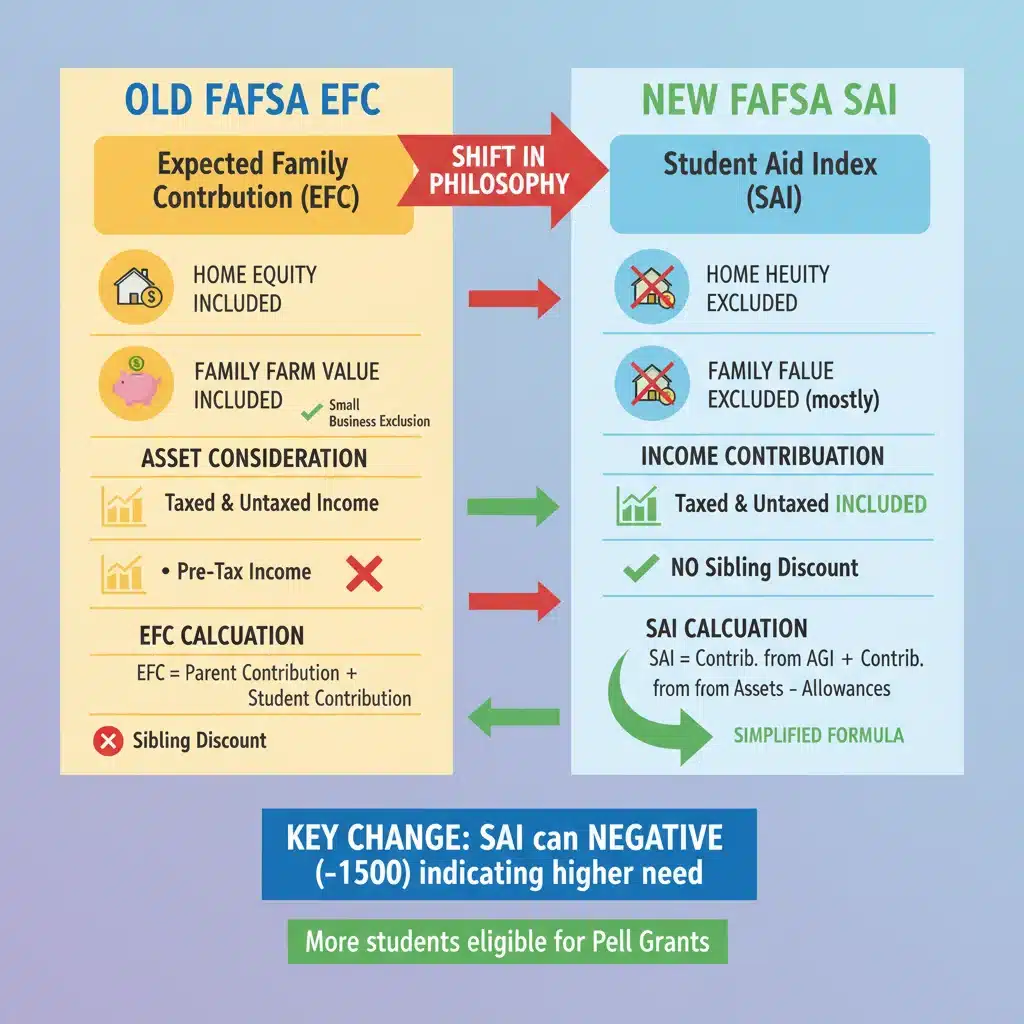
Perhaps the most significant of the 2026 FAFSA Changes is the replacement of the Expected Family Contribution (EFC) with the Student Aid Index (SAI). While both terms aim to represent a student’s financial need, the underlying methodology and implications are notably different. The EFC was often a source of confusion, as it wasn’t necessarily the amount a family was expected to pay out-of-pocket, but rather an index used by colleges to determine aid. The SAI aims to be a more transparent indicator of a student’s ability to pay for college, and crucially, it can be a negative number, indicating a higher level of financial need and potentially greater eligibility for federal grants.
Anúncios
What is the Student Aid Index (SAI)?
The SAI is an eligibility index that financial aid administrators use to determine how much federal student aid a student is eligible to receive. Unlike the EFC, the SAI can range from -1,500 to a maximum value, allowing for a more nuanced assessment of extreme financial need. A negative SAI indicates a student with significant financial need, potentially qualifying them for the maximum Pell Grant award, even if their family income is above previous thresholds. This change is a direct result of the FAFSA Simplification Act, which aims to expand access to federal student aid, particularly for low-income students.
Key Differences Between EFC and SAI in the 2026 FAFSA Changes
- Negative SAI: As mentioned, the ability for the SAI to be negative (-1,500 to be precise) is a major departure from the EFC, which could only go as low as zero. This change recognizes that some families have virtually no ability to contribute to college costs.
- Pell Grant Eligibility: The 2026 FAFSA Changes tie Pell Grant eligibility directly to family size and federal poverty levels, making it easier for some students to qualify without a complex calculation. This is a significant simplification and expansion of Pell Grant access.
- Number of Students in College: Under the old EFC formula, having multiple children simultaneously enrolled in college significantly reduced the EFC per student. The new SAI calculation, however, eliminates this benefit. This is one of the most impactful 2026 FAFSA Changes for families with multiple children pursuing higher education, as it could substantially increase their out-of-pocket costs. We will explore strategies to mitigate this impact later in this guide.
- Child Support: Previously, child support received was counted as untaxed income. With the 2026 FAFSA Changes, child support received will now be treated as an asset, which typically has a much smaller impact on aid eligibility than income. This is generally a positive change for recipients of child support.
- Small Business and Farm Exclusion: The asset protection allowance for small businesses and family farms (with 100 or fewer full-time employees) has been removed. This means the net worth of these assets must now be reported and will be considered in the SAI calculation, which could affect aid eligibility for families who own such assets.
These fundamental shifts underscore the importance of understanding the 2026 FAFSA Changes. What worked for older siblings or previous generations may no longer apply, necessitating a fresh approach to financial aid planning.
Impact on Income and Assets: What the 2026 FAFSA Changes Mean for Your Finances
The way income and assets are assessed is critical to your SAI. The 2026 FAFSA Changes introduce several modifications that could significantly alter your eligibility for federal student aid. It’s essential to understand these nuances to plan effectively.
Income Assessment Under the New SAI
The primary income information used for the FAFSA will continue to come from prior-prior year tax data. For the 2026-2027 academic year, this means your 2024 tax information will be used. The good news is that the IRS Direct Data Exchange (DDX) will be mandatory, simplifying the process of transferring tax information directly from the IRS to the FAFSA. This aims to reduce errors and make the application process smoother for many families.
- Adjusted Gross Income (AGI): AGI remains a core component of the income calculation. However, the calculation of discretionary income, which impacts how much of your income is considered available for college costs, has been updated.
- Untaxed Income: As noted, child support received will no longer be counted as untaxed income but as an asset. This is a favorable change for many families.
- Student Income: The amount of income a student can earn before it significantly impacts their aid eligibility has increased. This encourages students to work and save without being unduly penalized.
Asset Assessment Under the 2026 FAFSA Changes
The asset questions have also seen substantial revisions. Understanding which assets count and how they are weighed is vital for strategic financial planning.
- Small Business and Farm Net Worth: This is a major change. Previously, small businesses and family farms with fewer than 100 employees were excluded from asset calculations. Under the 2026 FAFSA Changes, their net worth (assets minus liabilities) must now be reported and will be included in the SAI calculation, which could significantly impact families who own such enterprises, potentially increasing their SAI and reducing their aid eligibility.
- Cash, Savings, and Checking Accounts: These liquid assets continue to be reported.
- Investments: Non-retirement investments, such as mutual funds, stocks, bonds, and real estate (other than the primary residence), are still considered assets.
- 529 Plans: Grandparent-owned 529 plans, which previously counted as untaxed income to the student when distributions were made, will no longer negatively impact the SAI. Only parent-owned (or dependent student-owned) 529 plans are considered assets, and they are assessed at a significantly lower rate than student-owned assets. This is one of the most beneficial 2026 FAFSA Changes for families with grandparent-funded college savings.
- Primary Residence: The value of your primary residence continues to be excluded from asset calculations, which is a relief for many homeowners.
The changes to asset reporting, particularly for small businesses and grandparent-owned 529 plans, require careful attention. Families should review their asset allocation well in advance of applying for aid to ensure they are positioned optimally under the new rules.
Specific Scenarios and the 2026 FAFSA Changes
Beyond the general income and asset changes, certain family situations will be particularly affected by the 2026 FAFSA Changes. Understanding these specific impacts is crucial for tailored planning.
Divorced or Separated Parents
One of the most welcome 2026 FAFSA Changes for children of divorced or separated parents concerns which parent’s information should be reported. Previously, the FAFSA required the financial information of the parent with whom the student lived the most during the past 12 months. Now, the FAFSA will require financial information from the parent who provides the most financial support to the student, regardless of where the student lives. This change aims to provide a more accurate picture of the family’s financial capacity to contribute to college costs and can be particularly advantageous if the parent providing the most financial support has lower income and assets.
Families with Multiple Children in College
As highlighted earlier, the elimination of the EFC reduction for having multiple children simultaneously enrolled in college is a significant aspect of the 2026 FAFSA Changes. This means that each student’s SAI will be calculated independently, potentially leading to a higher SAI for each child and a reduced aid package for families who previously benefited from this discount. This change will require families to re-evaluate their college savings and funding strategies. Strategies may include:
- Increased Savings: Proactive saving becomes even more critical.
- Exploring Other Aid Sources: Aggressively pursuing institutional scholarships, state grants, and private scholarships.
- Considering Less Expensive Schools: Re-evaluating college choices to include more affordable options.
- Income and Asset Management: Strategic planning of income and assets in years leading up to FAFSA submission for subsequent children.
Students with Unusual Circumstances
The 2026 FAFSA Changes also aim to improve the process for students with unusual circumstances, such as homelessness, foster care, or other special situations. The FAFSA Simplification Act provides clearer guidance for financial aid administrators to exercise professional judgment, making it easier for these students to receive the aid they need. This includes specific provisions for unaccompanied homeless youth and those in foster care.
Preparing for the 2026 FAFSA Changes: A Step-by-Step Action Plan
Proactive preparation is key to navigating the 2026 FAFSA Changes successfully. Here’s a step-by-step action plan for families:
Step 1: Understand Your Financial Snapshot
Before you even think about filling out the FAFSA, get a clear picture of your current financial situation. Gather your tax returns (especially 2024 for the 2026-2027 FAFSA), bank statements, investment statements, and any records related to child support. Understand your income streams and identify all your assets. Pay particular attention to small business net worth or farm assets, as these will now be included.
Step 2: Optimize Income and Assets Strategically
With the 2026 FAFSA Changes, strategic financial moves can make a difference. While it’s generally ill-advised to make drastic changes solely for financial aid purposes, some adjustments can be beneficial:
- Income Management: If possible, consider deferring bonuses or realizing capital gains in years that won’t be used for FAFSA calculations (i.e., not the ‘prior-prior year’).
- Asset Location: Move assets from a student’s name to a parent’s name, if feasible, as parent assets are assessed at a lower rate.
- Grandparent-Owned 529s: If grandparents have 529 plans, these are now more favorable. Distributions from these plans will no longer count as untaxed income to the student, offering a cleaner way for grandparents to contribute without negatively impacting aid.
- Paying Down Debt: Reducing consumer debt (credit cards, car loans) can improve your overall financial health, though it doesn’t directly impact FAFSA calculations as much as reducing mortgage or business debt might.
Step 3: Create an FSA ID Early
Both the student and at least one parent (the contributor) will need an FSA ID to access and sign the FAFSA. It’s crucial to create these well in advance, as the process can take a few days to verify information. An FSA ID is a username and password combination that serves as your electronic signature for the FAFSA.
Step 4: Familiarize Yourself with the New FAFSA Form
While the goal of the 2026 FAFSA Changes is simplification, the form itself will look different. There will be fewer questions, but understanding the new terminology and flow is important. The FAFSA will be available online, and the mandatory IRS Direct Data Exchange (DDX) will streamline the income reporting.
Step 5: File Your FAFSA as Early as Possible
The FAFSA typically opens on October 1st each year (though the 2024-2025 FAFSA opened later due to the overhaul). For the 2026-2027 academic year, aim to complete the FAFSA as soon as it becomes available. Many states and colleges award financial aid on a first-come, first-served basis, so early submission can significantly impact the amount of aid you receive.
Step 6: Review Your Student Aid Index (SAI) and Aid Offers
Once your FAFSA is processed, you will receive your Student Aid Index (SAI). This number will be sent to the colleges you listed on your FAFSA. Each college will then use your SAI to create a financial aid offer. Carefully review these offers, comparing them to understand the true cost of attendance at each institution. Don’t hesitate to reach out to financial aid offices with questions or if you believe there’s been an error.
Step 7: Appeal if Necessary
If your family’s financial situation has changed significantly since the prior-prior tax year (e.g., job loss, medical expenses, divorce), or if you believe your aid package doesn’t accurately reflect your ability to pay, you have the right to appeal. This is known as a ‘professional judgment’ review. Gather documentation to support your case and contact the financial aid office directly. Understanding the 2026 FAFSA Changes and how they apply to your unique situation will strengthen your appeal.
Long-Term Planning and the 2026 FAFSA Changes
Beyond immediate preparation, the 2026 FAFSA Changes necessitate a long-term perspective on college funding. These reforms are not a one-time event; they will shape financial aid for years to come.
College Savings Strategies
Given the elimination of the multi-child discount and the inclusion of small business assets, families need to re-evaluate their college savings strategies. 529 plans remain an excellent option, especially with the favorable treatment of grandparent-owned plans. Consider the timing of contributions and withdrawals to minimize impact on aid eligibility.
Understanding Net Price vs. Sticker Price
The sticker price of a college is rarely what a family actually pays. The ‘net price’—the cost after grants and scholarships are applied—is the true indicator of affordability. The 2026 FAFSA Changes, by potentially increasing Pell Grant eligibility and streamlining the process, aim to make net prices more transparent and accessible. Focus on understanding the net price when comparing aid offers.
Exploring All Avenues of Aid
Federal aid is just one piece of the puzzle. Families should vigorously pursue state grants, institutional scholarships (from the colleges themselves), and private scholarships from various organizations. Many scholarships are merit-based rather than need-based, providing an avenue for students regardless of their SAI.
Consulting a Financial Aid Advisor
Given the complexity of the 2026 FAFSA Changes, consulting with a financial aid advisor or college planning specialist can be invaluable. These professionals can provide personalized guidance, help you understand your specific situation under the new rules, and identify strategies to maximize your aid eligibility. Their expertise can save you time, stress, and potentially a significant amount of money.

Key Takeaways for the 2026 FAFSA Changes
As we conclude our deep dive into the 2026 FAFSA Changes, let’s recap the most critical points for families to remember:
- SAI Replaces EFC: The Student Aid Index (SAI) is the new measure of financial need, capable of being a negative number, indicating higher eligibility for aid.
- No Multi-Child Discount: The benefit for having multiple children in college simultaneously has been removed, potentially increasing costs for these families.
- Small Businesses and Farms Count: The net worth of small businesses and family farms (even with fewer than 100 employees) must now be reported as an asset.
- Child Support as Asset: Child support received is now considered an asset, generally more favorable than being counted as untaxed income.
- Grandparent 529s More Favorable: Distributions from grandparent-owned 529 plans will no longer negatively impact the student’s aid eligibility.
- Parent Providing Most Support: For divorced parents, the FAFSA will use the financial information of the parent who provides the most financial support, regardless of residency.
- Mandatory IRS DDX: The IRS Direct Data Exchange will be required, simplifying the transfer of tax information.
- Early Application is Key: Always submit your FAFSA as early as possible to maximize your chances for state and institutional aid.
- Professional Judgment: Don’t hesitate to appeal your aid package if your financial circumstances have changed or are not accurately reflected.
The 2026 FAFSA Changes represent a significant shift in how federal student aid is calculated and distributed. While the reforms aim to simplify the process and expand aid access, they also introduce new complexities that families must understand. By proactively educating yourselves, strategically managing your finances, and adhering to the application timelines, you can effectively navigate these changes and secure the best possible financial aid package for your student’s higher education journey. The future of college funding is here, and being informed is your most powerful tool.