
Roth IRA Conversion Strategies for High Earners in 2026: A US Tax Planning Perspective
For high-income earners in the United States, navigating the complexities of tax-efficient retirement savings is a perpetual challenge. Traditional retirement accounts often come with income limitations or tax deferral that eventually leads to significant tax burdens in retirement. This is where a Roth IRA Conversion becomes a powerful tool, offering a pathway to tax-free growth and withdrawals in retirement. As we look ahead to 2026, understanding the nuances of these strategies, potential legislative changes, and optimal timing is more critical than ever. This comprehensive guide will delve into advanced Roth IRA conversion strategies specifically tailored for high earners, providing a roadmap for maximizing your retirement wealth while minimizing your tax liabilities.
Anúncios
Understanding the Core Concept of a Roth IRA Conversion
At its heart, a Roth IRA Conversion involves moving pre-tax money from a traditional IRA, 401(k), or other qualified retirement plan into a Roth IRA. The primary benefit? Once converted, all qualified distributions in retirement are entirely tax-free. This stands in stark contrast to traditional IRAs, where distributions are taxed as ordinary income. For high earners, who often face higher marginal tax rates during their working years, the prospect of tax-free income in retirement is incredibly appealing, especially if they anticipate being in an even higher tax bracket later in life or if future tax rates are expected to rise.
The catch, of course, is that you must pay income tax on the amount converted in the year of the conversion. This immediate tax hit is often the biggest hurdle for individuals considering a Roth IRA Conversion. However, with careful planning and strategic execution, this upfront cost can be well worth the long-term tax savings. The decision hinges on several factors, including your current income, anticipated future tax rates, investment growth potential, and time horizon until retirement.
The year 2026 is particularly significant because it marks the sunset of certain provisions from the Tax Cuts and Jobs Act (TCJA) of 2017. Many individual income tax provisions are set to expire, which could lead to higher marginal tax rates across the board. This potential shift makes proactive tax planning, including strategic Roth conversions, even more compelling. High earners should be acutely aware of these impending changes and how they might impact the cost-benefit analysis of a Roth IRA Conversion.
Anúncios
Why High Earners Should Consider a Roth IRA Conversion in 2026
For individuals with substantial incomes, directly contributing to a Roth IRA is often not an option due to income limitations. In 2025 (and likely similar for 2026), the ability to make direct Roth IRA contributions phases out for single filers with modified adjusted gross income (MAGI) between $146,000 and $161,000, and for married couples filing jointly with MAGI between $230,000 and $240,000. This is where the Roth IRA Conversion, often through the ‘backdoor Roth’ strategy, becomes indispensable.
Beyond overcoming income limits, several other reasons make a Roth IRA Conversion attractive for high earners:
- Anticipated Higher Future Tax Rates: If you believe tax rates will be higher in retirement or if your income bracket will increase, paying taxes now at potentially lower rates makes sense. The sunset of TCJA provisions in 2026 reinforces this concern.
- Tax-Free Growth and Withdrawals: This is the holy grail of Roth accounts. All earnings grow tax-free, and qualified withdrawals in retirement are also tax-free. This can equate to hundreds of thousands, if not millions, in tax savings over decades.
- No Required Minimum Distributions (RMDs) for the Original Owner: Unlike traditional IRAs, Roth IRAs do not have RMDs for the original owner. This provides greater flexibility in managing your retirement income and allows your assets to continue growing tax-free for longer. This is particularly valuable for estate planning, as beneficiaries can also benefit from tax-free withdrawals for a period.
- Estate Planning Benefits: Roth IRAs can be excellent tools for wealth transfer. Because there are no RMDs for the original owner, the account can grow untouched for your entire lifetime and then pass to your beneficiaries. While beneficiaries are subject to RMDs (under the SECURE Act’s 10-year rule for most non-spouse beneficiaries), their distributions are still tax-free.
- Diversification of Tax Buckets: A well-rounded retirement plan includes assets in different ‘tax buckets’: taxable accounts (e.g., brokerage accounts), tax-deferred accounts (e.g., traditional 401(k), IRA), and tax-free accounts (e.g., Roth IRA, Roth 401(k)). A Roth IRA Conversion helps build up your tax-free bucket, giving you more control over your taxable income in retirement.
The ‘Backdoor Roth’ Strategy: A High-Earner Staple
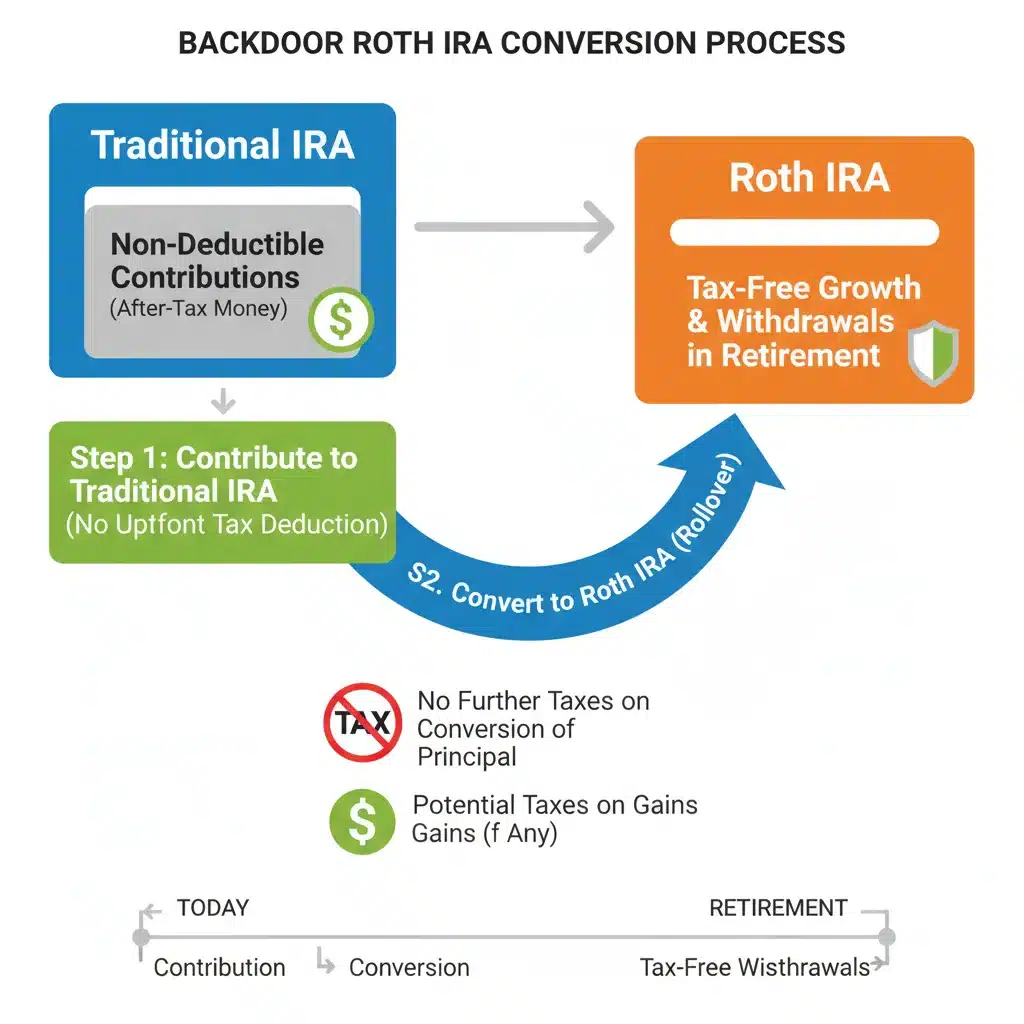
For high earners whose income exceeds the direct Roth IRA contribution limits, the ‘backdoor Roth’ is a widely used and perfectly legal strategy to get money into a Roth account. This strategy involves two main steps:
- Make a Non-Deductible Contribution to a Traditional IRA: Since high earners often can’t deduct traditional IRA contributions due to income limits or participation in an employer-sponsored retirement plan, they can still contribute to a traditional IRA on a non-deductible basis. This means you contribute after-tax money.
- Convert the Non-Deductible Traditional IRA Contribution to a Roth IRA: Shortly after making the non-deductible contribution, you convert that money (and any negligible earnings) to a Roth IRA. Since the original contribution was after-tax, only any investment gains that occurred between the contribution and the conversion would be taxable. If done quickly, these gains are usually minimal, making the tax hit on the conversion very small or even zero.
The key to the backdoor Roth IRA Conversion strategy is understanding the ‘pro-rata rule.’ This rule states that if you have any pre-tax money in *any* traditional IRA accounts (including SEP IRAs and SIMPLE IRAs, but generally not employer 401(k)s), a portion of your conversion will be taxable, even if you just contributed non-deductible funds. The IRS looks at all your traditional IRA balances combined. To avoid this, it’s often advisable to roll any existing pre-tax IRA money into an employer 401(k) or 403(b) if possible, before executing a backdoor Roth.
Advanced Roth IRA Conversion Timing and Tax Considerations for 2026
The timing of your Roth IRA Conversion can significantly impact its tax efficiency. Here are advanced considerations for high earners in 2026:
1. The TCJA Sunset and Potential Higher Tax Rates
As mentioned, 2026 is a pivotal year due to the expiration of many individual tax provisions from the TCJA. This could mean a return to higher marginal income tax rates. For high earners, this presents a strategic window: converting in 2025 or even early 2026, while current (potentially lower) tax rates are still in effect, could lock in significant tax savings compared to converting after the rates potentially increase. Assess your income projections for 2025 and 2026 carefully. If you anticipate a year with unusually low income (e.g., a sabbatical, career change, or business downturn), that could be an ideal time to perform a larger Roth IRA Conversion.
2. Managing the Tax Bill
The tax liability from a Roth IRA Conversion can be substantial. It’s crucial not to pay the conversion tax directly from the IRA itself, as this reduces the amount that grows tax-free and can even trigger an early withdrawal penalty if you’re under 59½ on the amount used for taxes. Instead, plan to pay the taxes from non-retirement funds. This keeps the full converted amount growing tax-free within the Roth IRA.
3. Partial Conversions and Tax Bracket Management
You don’t have to convert your entire traditional IRA balance at once. Many high earners opt for a series of partial Roth IRA Conversions over several years. This allows them to manage the tax impact by staying within a desired tax bracket. For example, you might convert just enough each year to fill up your current marginal tax bracket (e.g., the 24% or 32% bracket) before pushing into a higher one. This incremental approach can be highly effective for long-term tax planning.
4. Consider Market Downturns
A significant market downturn can present an opportune moment for a Roth IRA Conversion. When the value of your traditional IRA assets drops, the tax cost of converting those assets also decreases. If you convert during a dip and the market recovers, all that subsequent growth occurs tax-free within your Roth IRA. This requires a strong stomach and a belief in market recovery, but it can supercharge your Roth growth.
5. The Five-Year Rule
Be aware of the Roth IRA’s five-year rule. There are two distinct five-year rules:
- Five-Year Rule for Contributions: Your Roth IRA must be open for at least five years from January 1st of the year you made your first contribution (direct or conversion) to make qualified withdrawals of earnings tax-free.
- Five-Year Rule for Conversions: Each Roth IRA Conversion has its own five-year waiting period. If you withdraw the converted amount (principal, not earnings) within five years of the conversion, it may be subject to a 10% early withdrawal penalty if you are under 59½. This rule is less critical if you don’t plan to touch the converted funds for many years.
For high earners, these rules typically aren’t a major impediment, as the goal is usually long-term growth and withdrawals in true retirement. However, it’s essential to understand them, especially if you foresee needing access to funds sooner.
Beyond the Backdoor: Mega Backdoor Roth and In-Plan Conversions
While the standard backdoor Roth is common, some high earners can leverage even more advanced strategies:
Mega Backdoor Roth
This strategy is available if your employer’s 401(k) plan allows after-tax contributions and in-service distributions (either to a Roth 401(k) or a Roth IRA). The steps are:
- Maximize Your 401(k) Contributions: Contribute the maximum allowable to your pre-tax or Roth 401(k) ($23,000 in 2024, likely higher in 2026, plus catch-up if 50+).
- Make After-Tax Contributions: If your plan allows, contribute additional after-tax money up to the overall IRS limit for defined contribution plans ($69,000 in 2024, including employer contributions).
- Convert After-Tax Funds: Periodically (or annually), convert these after-tax contributions from your 401(k) to a Roth IRA (or an in-plan Roth 401(k) conversion). Since these contributions were already taxed, the conversion is usually tax-free.
The mega backdoor Roth can allow high earners to contribute tens of thousands of dollars more per year into a Roth account than the standard backdoor Roth, significantly accelerating tax-free wealth accumulation. Check with your plan administrator if your 401(k) supports this feature.
In-Plan Roth Conversions
Some employer plans (401(k), 403(b), 457(b)) allow for in-plan Roth conversions. This means you can convert pre-tax money within your employer plan directly to a Roth sub-account within the same plan. The tax implications are similar to an IRA-to-Roth IRA conversion (you pay taxes on the converted amount), but the funds remain within the employer plan. This can be beneficial if you prefer to keep all your retirement assets consolidated in one place or if you want to avoid the pro-rata rule issues that can arise with IRA conversions.

Key Considerations and Potential Pitfalls
While a Roth IRA Conversion offers significant benefits, it’s not without its complexities. High earners must be mindful of several factors:
- Tax Bill Shock: The immediate tax liability is the most significant hurdle. Ensure you have sufficient non-retirement funds to cover this tax.
- Pro-Rata Rule for Backdoor Roth: As discussed, if you have existing pre-tax IRA money, the pro-rata rule will apply, making a portion of your backdoor Roth conversion taxable. Strategies to mitigate this include rolling pre-tax IRAs into an employer 401(k).
- Impact on Modified Adjusted Gross Income (MAGI): A large Roth IRA Conversion increases your taxable income for the year, which in turn increases your MAGI. A higher MAGI can impact other tax-related items, such as eligibility for certain deductions and credits, or the cost of Medicare premiums (IRMAA – Income-Related Monthly Adjustment Amount) in future years. Plan accordingly if you are close to income thresholds for these items.
- Future Tax Law Changes: While we anticipate changes in 2026, future administrations could enact new tax laws that affect Roth accounts. However, historically, Congress has been reluctant to retroactively tax Roth earnings or withdrawals.
- Investment Horizon: The longer your money has to grow tax-free in a Roth IRA, the more beneficial the conversion. If you’re close to retirement, the benefit might be less pronounced, though still valuable for RMD avoidance and estate planning.
- Professional Guidance: Given the complexities, especially for high earners, consulting with a qualified financial advisor and tax professional is highly recommended. They can help you model different scenarios, understand the impact on your overall financial plan, and ensure compliance with all IRS rules.
Developing Your Roth IRA Conversion Strategy for 2026
Crafting an effective Roth IRA Conversion strategy for 2026 requires a holistic view of your financial situation. Here’s a framework high earners can follow:
- Assess Your Current and Projected Income: Understand your marginal tax bracket now and what it might be in 2026 and beyond. Consider any anticipated income fluctuations.
- Evaluate Your Existing Retirement Accounts: Inventory all your traditional IRAs, SEP IRAs, SIMPLE IRAs, and 401(k)s. Determine the pre-tax and after-tax components.
- Analyze the Pro-Rata Rule Impact: If you have substantial pre-tax IRA money, explore options like rolling it into an employer 401(k) before attempting a backdoor Roth.
- Determine Conversion Amounts and Timing: Decide whether a single large conversion or a series of smaller, partial conversions over several years makes the most sense to manage your tax bracket. Consider converting during market dips.
- Plan for the Tax Bill: Set aside funds from non-retirement accounts to pay the conversion tax.
- Consider the Mega Backdoor Roth: If your employer plan allows, investigate if the mega backdoor Roth is an option to supercharge your Roth savings.
- Review Estate Planning Goals: How does a Roth IRA fit into your overall estate plan for wealth transfer?
- Consult with Professionals: Engage a financial planner and tax advisor to guide you through the process, ensure compliance, and optimize your strategy. They can help you understand the specific implications of the 2026 tax law changes for your unique situation.
Conclusion: Seizing the Opportunity with Roth IRA Conversions
For high-income earners, a Roth IRA Conversion is more than just a retirement savings tactic; it’s a sophisticated tax planning strategy that can profoundly impact your financial future. The potential for tax-free growth and withdrawals, coupled with the flexibility of no RMDs, makes it an invaluable tool for building lasting wealth. As we approach 2026 and the potential for shifts in the tax landscape, the urgency and opportunity for strategic Roth conversions become even clearer.
By understanding the mechanics of direct conversions, mastering the backdoor Roth, exploring mega backdoor options, and carefully considering the tax implications and timing, high earners can effectively navigate the complexities. Proactive planning, often in consultation with financial and tax experts, will be key to unlocking the full potential of a Roth IRA Conversion and securing a more tax-efficient retirement for yourself and your beneficiaries. Don’t let income limits or the immediate tax hit deter you from exploring this powerful strategy; the long-term benefits can be truly transformative.